Showing posts with label economics. Show all posts

Tuesday, June 4, 2013

How To Predict A Market Bubble. - Forecast Convergence Density

Share this ARTICLE with your colleagues on LinkedIn .


As a Global Futurist, I use multiple sources and multiple variables, in combination with historical trends, cycles, and other predictions made by other "Gurus" and "Pundits". I believe in three very basic ways of analyzing the future: The first is by observing historically-proven cause and effect relationships; the second is the length of certain short-term and longer-term economic cycles; and the third is one of my favorites, which I will call "Forecast Convergence Density".

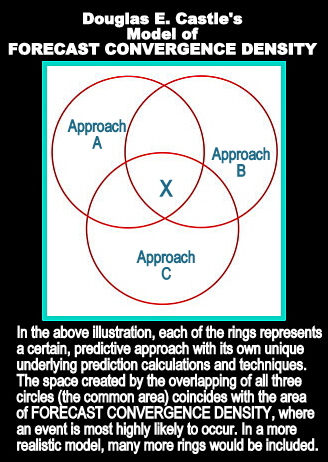
Forecast Convergence Density  - Douglas E. Castle

"Forecast Convergence Density" is a simple logical model, and dictates that "the probability of some event's occurrence is directly proportional to the percentage of a large group of diverse, different and independent predictive techniques (which I've selected) which predict that event's occurrence."

More simply put, "if the majority of the predictive approaches and the persons who champion each of them independently (to best minimize autocorrelation) and respectively say that something is going to happen, the probability that it will happen increases."

The approach is very sensible, can be easily utilized by most reasonably intelligent businesspersons, and puts its faith in a variant of the majority vote principle -- or perhaps less flatteringly, "going with the herd."

It must be emphasized that this approach is highly simplistic and is quite inexact in terms of viability with a small number of approaches drawn, as above, as if in a part of a Venn Diagram.  By my theory, reliability of the area of Forecast Convergence density increases with the number of non-auto-correlative predictive approaches used.
---------------

And, now an article culled from The Motley Fool speaks about specifically forecasting the timing (but not so much the magnitude) of various economic bubbles. In this article, we are given an idea of timing, frequency, but not amplitude of the adjustment or correction. 

Why Spotting Bubbles Is So Much Harder Than You Think - [Excerpted From The Motley Fool]


It's that time again.

A growing group of pessimists are asking whether the stock market is back to bubble territory. Some are even comparing it to 1999. They say stocks are being inflated by the Fed. That they're disconnected from the reality of a weak economy. That they're overvalued and bound to fall.

Could they be right? Of course.

They make a forceful case with charts and ratios and historical data.
But they have been making the same argument for four years now, and they have been wrong all the way. Clearly, the world is more complicated than the pessimists assume.
Consider that the S and P 500 has risen as much as 60% since these quotes went to press:
"The S&P 500 is about 40 percent overvalued" -- October, 2009
"US Stocks Surge Back Toward Bubble Territory" -- January, 2010
"On a valuation basis, the S&P 500 remains about 40% above historical norms on the basis of normalized earnings." -- July, 2010
"Is The Stock Market Overvalued? Almost Every Important Measure Says Yes" -- November, 2010
"The market is as overvalued now as it was undervalued [in early 2009]," said David A. Rosenberg, chief economist and strategist for Gluskin Sheff, an investment firm." -- March, 2010
"Andrew Smithers, an excellent economist based in London, is telling us that we're way too optimistic, that fair value for the S&P 500 is actually in the 700-750 range. Smithers, therefore, thinks the stock market is about 50% overvalued." -- June, 2010
Sure, you might say these calls were just early. But let me put forth a truism in finance: When an average business cycle lasts five years, there is no such thing as four years ahead of the game. You are just wrong.

Some of the bubble arguments haven't changed in the face of a 50% rally. Take the cyclically adjusted price/earnings ratio, or CAPE. In 2010, the S&P 500, which traded near the 1,000 level, had a CAPE valuation of around 22, which many pointed out was about 40% above historic norms. Today, trading above 1,600, the S&P 500 has a CAPE of about ... 23.

Even as the market exploded higher, the degree to which the market is supposedly overvalued hasn't changed that much, since companies have been busy investing in their operations and boosting earnings. That's why being four years early means being four years wrong.

My point here isn't to relish in other people's bad predictions -- although I never tire of doing so. And let's state loud and clear: The higher the market goes today, the lower returns will be tomorrow. There will be more recessions, pullbacks, crashes, and panics in the future.
But there are several lessons we can learn from four years of failed bubble predictions.

1. Never rely on single-variable analysis. Einstein said, "Everything should be made as simple as possible, but not simpler."

Wall Street blew up in 2008 after relying on mind-blowingly complex forecasting models that attempted to measure risk out to the fifth decimal point. Most investors now realize how flawed these complicated models were. But then they turn around and do the opposite, dramatically oversimplifying by trying to explain the global economy with a single metric.

That's just as crazy.

History tells us that the single best gauge of future market returns is current valuations. But even a rational valuation measure like CAPE only has a small amount of predictive power.
The single most powerful variable when trying to predict the future is the "X" factor that represents human psychology, historical unknowns, and random chance. It doesn't care about your political views or what you think is a fair market value, and it's going to humiliate your predictions 90% of the time.

2. Realize that some analysts are stubborn to a fault
Some people predicted the financial crisis in 2008. And good for them. But many of them also predicted a financial crisis in 2007, 2006, 2005, 1997, 1995, 1992, 1985, 1970, and so on. They are perma-bears who get ignored during booms and lionized during busts, even though their arguments rarely change. It's the classic broken-clock-is-right-twice-a-day syndrome.

Author Daniel Gardner wrote earlier this year:
In 2010, [Robert] Prechter said the Dow would crash to 1,000 this year or in the near future. The media loved it. Prechter's call was reported all over the world. Which was nice for Prechter.
Even better, very few reporters bothered to mention that Prechter has been making pretty much the same prediction since 1987.
It was similar for investor Peter Schiff. There's a great YouTube video -- worthy of some 2.1 million views -- of Schiff predicting a market crash circa 2007. That was an excellent call. But here's another video of Schiff in 2002 predicting all kinds of gloom that never happened. Sadly, that video received only a handful of views. Gardner writes in his book Future Babble:
[Schiff predicted the 2008 crisis,] but it's somewhat less amazing if you bear in mind that Schiff has been making essentially the same prediction for the same reason for many years. And the amazement fades entirely when you learn that the man Schiff credits for his understanding of economics -- his father, Irwin -- has been doing the same at least since 1976.
The ideal pundit is one with a flexible mind who doesn't become wedded to forecasts for ideological reasons. Alas, few of them exist.

3. Missing a rally can be more devastating that getting caught in a crash
The vast majority of entrepreneurs, business leaders, policymakers, teachers, and consumers try hard to make the world a better, more productive place. In aggregate, they succeed the vast majority of the time. That's why there's a strong upward bias to equity markets over time.

It's also why missing a market rally can be a bigger risk to your finances than getting caught up in a crash. Getting caught in a crash usually means having to wait a few years at most -- which everyone invested in stocks should be prepared to do. But missing a rally can be a permanently lost opportunity. People spend so much time trying to avoid temporary pullbacks that they forego enduring market gains. If that's your thing, stick with bonds -- stocks aren't for you.

I can say with high confidence that over the next 20 years we will have several severe market pullbacks, yet stocks will trade substantially higher than they do now.
Why focus on the former and ignore the latter?

Check back every Tuesday and Friday for Morgan Housel's columns on finance and economics. 

####

Well explained and well played Mr. Morgan Housel (one of the Motley Fools). Yet I feel more comfortable predicting things using my Forecast Convergence Density Model.

Thank you for reading me, and for sharing my articles with your friends, colleagues and contacts through your various social media platforms and forums.


View DOUGLAS E. CASTLE's profile on LinkedIn


Share this page
Contact Douglas Castle
Follow Me on Pinterest


CFI, C.F.I., CrowdFunding Incubator,  crowdfunding, crowd funding, incubators, accelerators, finance projects, listing services, start up, small business, SME, funding, capitalization, financing, leverage, company services, management, marketing, fundraising, technology, mentoring, advice, media, branding, memes, business tips tricks tools and resources, entrepreneur, forum, discussion, applications, technologies, risk assessment, business model, strategic planning, organizational development, connections, networking, early-stage, first-round, angel  funding, venture capital, credit lines, assistance, business growth, biz builders, social media power, delegation, automation, monitoring, metrics, brainstorming, meetups, joint ventures, partnerships - http://CFICrowdFundingIncubator.blogspot.com, http://www.CrowdFundingIncubator.com, marketing, messaging, news releases, free, gain market share, increase backlinks, SEO, influence, disruption theory, directory, RSS feeds, Douglas E. Castle, blogroll, blogs, crowdfunding blogs...
crowdfunding websites, crowdfunding incubators, crowdfunding platforms, crowdfunding startups, crowdfunding news, crowd funding news, crowdfunding updates, crowdfunding rss feeds, crowdfunding incubator, CrowdFunding Incubator, crowdfunding accelerator, crowdfunding projects, crowdfunding ventures, crowdfunding sites, crowdfunding associations, crowdfunding organizations, crowd funding, project finance, micro loans, venture capital, micro-ventures, angel funding, crowd funding, project fundraising, crowd funding sites, crowd funding resources, crowdfunding tips tricks tools techniques, CFI, CrowdFunding Incubator LLC, crowdfunding capital, capital sources, CFI Featured Projects, CFI CrowdFunding Incubator, Crowd Funding RSS Feeds, CrowdFunding Incubator C.F.I., SME, SBA, MBE, WBE, DBE small business grants, loans, credit, growth capital, non-bank, fund a project, kickstarter, Indiegogo, crowd funding start ups, new crowd funding sites, crowd funding laws, JOBS Act, crowd funding contests, entrepreneurs, innovators, inventors, applications, funding technology, growth capital, seedling businesses, kiva, socially responsible projects, crowdsourcing, crowd sourcing, funding phases, business plans, presenting your business idea, crowd forums, government business assistance programs, business mentoring, free business resources and advice, http://www.CrowdFundingIncubator.com, http://www.CFICrowdFundingIncubator.com, http://www.CFIEnterpriseResourcesGroup.com, Douglas E. Castle blogs...


***
View DOUGLAS E. CASTLE's profile on LinkedIn

Douglas E. Castle - Blogger Profile
CFI - Notes From The CEO
Instant Musical Counterpoint - Relax!

WebCrawler - Scrub The Entire Web For Everything About Future Prediction


Friday, April 12, 2013

Shocking World Forecasts: 2013 - 2063

Share this ARTICLE with your colleagues on LinkedIn .


As the author of The Global Futurist Blog, I take the more conservative road in predictions.

When I forecast for the near-term, I endeavor to keep my visionary insights turned off to the greatest extent possible, while I choose certain specific variable relating to equally specific trends which I feel will either peak and fall (in the fairly near-term), or which have sufficient gravity (as used here, I am speaking of combination of such factors as: their importance to the economy; widespread media coverage; ongoing research grant allocations and investment; the amplitude of the change they would create; the power of the established industries or technologies which they would have to -- David and Goliath style -- disrupt and displace; and the views of other futurists and prognosticators looking at the same variables in the shorter-term) to be carried forward and create a serious rippling effect,  radical sociological paradigm shift or revolutionary technological change.

I've only chosen a few items to focus on, and they are in areas where: the trending is swelling in amplitude; there are limits in accessibility to depletable resources (a finite quantity parameter); there are artificially subsidized or sustained institutions, industries or practices;
there are untenable compromises which foster instability; there are urgent changes required for society's and Humanity's survival; or, where there are institutions which are fatalistic by their nature, and have a "loot and pillage all that we can RIGHT NOW" mentality while the New Rome (or Babylon) burns, or while the Titanic slips into the freezing depths of an unforgiving dispassionate ocean.

I'll limit my global forecasts for the 50-year time frame to a simple outline form without going into the reasoning behind them in great detail:

1) The world's supply of potable water will be scarce, and Israeli desalinization technology will be used, subject to license, by many nations. There will be mass starvation and famine in Africa, parts of the Middle East, island republics and the Amazon;

2) Climate change, unpredictable and increasingly volatile, will create great damage to world infrastructure, significant alterations to continental positions, the decimation of some island civilizations and will make travel increasingly difficult;

3) There will be increased clashes between deprived and infuriated citizens (or servants or subjects) and the governments which have bankrupted them and helped to enslave them;

4) Asia will lose its economic advantage, and that advantage will move to parts of industrialized Europe, with some benefit to the United States.

5) The Caucasian and poorly educated minority of the U.S. citizenry will become increasingly armed and hostile toward the government, and violent (but media-suppressed)skirmishes will ensue; the demography of the U.S. will shift in favor of Latinos and Asians, and virtually all employment with the exception of the entrepreneurial sector, will be by governments or their agencies;

6) There will be bloody war in the Middle East and parts of Africa between Shiite Muslims and Sunni Muslims;

7) Fossil fuels will decrease in use and utility as their availability is compromised by surface transport issues;

8) The United States will be militarily involved in multiple wars throughout the world;

9) Complete invisibility cloaking will be in use by covert and acknowledged government agencies domestically and internationally.

10) Plasma, laser and other wave-based or radiation-based weapons will be in ordinary use.

11) Mexico will become a rogue state, run by a coalition of corrupt government officials and the drug lords. Other countries will likely follow suit;

12) There will have been a shift toward atomic energy;

13) There will have been a shift from internet to satellite communications;

14) Entire limbs and organs will be grown utilizing stem cells combined with electromagnetic technology and genetic engineering, and for the few who can afford it, the Human lifespan will have been increased to in excess of 130 years. Females will outlive males. The average lifespan due to environmental and socio-economic factors will decrease significantly from where it is today;

15) Those persons who can get work will be telecommuting from their secured residences, and most recreation will not take place outside secured zones in enclosed areas;

16) A great deal of recreational time will be spent in virtual reality, as an escape into fantasy from the harsh realities of future life;

17) Society will not have attained Kurzweil's point of Singularity, but substantially all menial, physical or clerical jobs will be undertaken by robots. Machines will build machines, but none will exhibit genuine Artificial Intelligence;

18) There will be movements amongst various governments to eliminate paper currency to facilitate better tracking of money, materiel and personnel, as well as to simplify the tax collection process. There will be riots in otherwise civilized countries over this;

19) Most device and access security will be by a combination of biometrics instead of encryption;

20) Humanity will be de-socialized to the extent that we will be living in a sort of high-technology Medieval revival, with corporate-government cartels being the lairds of their respective territories, and individuals will serve them, putting country and citizenship affiliations second;

21) Most of the world's wealth will be controlled by less than 1% of the total population -- the other 99% will be struggling for survival in a polluted, unsafe, violent world -- a world overcome by the madness that comes of hyper-vigilance and constant fear;

22) Most educated couples will choose not to have children, while the uneducated will continue to create families which they cannot responsibly support;

23) Pollution in Asia and in certain parts of Latin America will make the air quality so poor that people will not be able to spend any time outdoors, except with air filtration gear;

24) Most of the world's peoples will be living in abject poverty, and will literally be fighting for their their lives;

25) The tremendous resurgence which we are witnessing today amongst the Doomsday Preppers, the End-Times Groups and the militant anti-government groups is ultimately a foreshadowing of items 1 through 24, above. As someone once told me, "Just 'cause you's paranoid don't mean that they ain't out to get you." In these extreme cases, these groups are partially prophetic and partially a disparate self-fulfilling prophesy. There will be incidents involving drones killing innocents, planned assassinations, chemical and biological tests gone wrong and some tragedies involving 'dirty nukes'.  Rhetorically-justified lawlessness will be the privilege of  those who can either choose to be or  pay to be exempt from the law.

---------------

I also believe that there will be the promising beginnings of colonization of other planets or their moons by the next wave of Human pioneers, and they will be Humankind's greatest hope for the future. These colonists will have wonderful, powerful technologies to aid them in their re-creation of a society, but (and this is conjecture -- not forecast), hopefully these few will have sociologically, psychologically and spiritually advanced to the point that they do not want to invest in a zero-sum game.

Instead, I hope that these few will be collaborative, and see the very notion of civilization as a goal to be striven for above all else except for the right to be different from others, but yet fully accepting of them.

Thank you, as always for reading me, and for sharing my articles with your colleagues and connections over the interconnectedness of social media.

Douglas E. Castle

Sponsored By:
CFI - CrowdFunding Incubator LLC
Global Edge Technologies Group LLC
ICS - International Connection Services


View DOUGLAS E. CASTLE's profile on LinkedIn


Share this page
Contact Douglas Castle
Follow Me on Pinterest


CFI, C.F.I., CrowdFunding Incubator,  crowdfunding, crowd funding, incubators, accelerators, finance projects, listing services, start up, small business, SME, funding, capitalization, financing, leverage, company services, management, marketing, fundraising, technology, mentoring, advice, media, branding, memes, business tips tricks tools and resources, entrepreneur, forum, discussion, applications, technologies, risk assessment, business model, strategic planning, organizational development, connections, networking, early-stage, first-round, angel  funding, venture capital, credit lines, assistance, business growth, biz builders, social media power, delegation, automation, monitoring, metrics, brainstorming, meetups, joint ventures, partnerships - http://CFICrowdFundingIncubator.blogspot.com, http://www.CrowdFundingIncubator.com, marketing, messaging, news releases, free, gain market share, increase backlinks, SEO, influence, disruption theory, directory, RSS feeds, Douglas E. Castle, blogroll, blogs, crowdfunding blogs...
crowdfunding websites, crowdfunding incubators, crowdfunding platforms, crowdfunding startups, crowdfunding news, crowd funding news, crowdfunding updates, crowdfunding rss feeds, crowdfunding incubator, CrowdFunding Incubator, crowdfunding accelerator, crowdfunding projects, crowdfunding ventures, crowdfunding sites, crowdfunding associations, crowdfunding organizations, crowd funding, project finance, micro loans, venture capital, micro-ventures, angel funding, crowd funding, project fundraising, crowd funding sites, crowd funding resources, crowdfunding tips tricks tools techniques, CFI, CrowdFunding Incubator LLC, crowdfunding capital, capital sources, CFI Featured Projects, CFI CrowdFunding Incubator, Crowd Funding RSS Feeds, CrowdFunding Incubator C.F.I., SME, SBA, MBE, WBE, DBE small business grants, loans, credit, growth capital, non-bank, fund a project, kickstarter, Indiegogo, crowd funding start ups, new crowd funding sites, crowd funding laws, JOBS Act, crowd funding contests, entrepreneurs, innovators, inventors, applications, funding technology, growth capital, seedling businesses, kiva, socially responsible projects, crowdsourcing, crowd sourcing, funding phases, business plans, presenting your business idea, crowd forums, government business assistance programs, business mentoring, free business resources and advice, http://www.CrowdFundingIncubator.com, http://www.CFICrowdFundingIncubator.com, http://www.CFIEnterpriseResourcesGroup.com, Douglas E. Castle blogs...


***
View DOUGLAS E. CASTLE's profile on LinkedIn

Douglas E. Castle - Blogger Profile
CFI - Notes From The CEO
Instant Musical Counterpoint - Relax!

WebCrawler - Scrub The Entire Web For Everything About Future Prediction


Tuesday, November 13, 2012

US Oil Addiction: Deadly Denial

Share this ARTICLE with your colleagues on LinkedIn .


The Global Futurist Blog is predicting that The US' addiction to oil is going to persist, and will probably increase during the next fifteen- to twenty-year time horizon. This is not for lack of interest in alternative forms of energy, or for any lack of existing (or currently developing) substitutes or supplements to oil - it will primarily be due to Big Oil's increasing aggressiveness in domestic oil extraction under the patriotic guise of "oil independence" from middle eastern sources of supply -- who are constantly blamed (scapegoating) for the high price and limited availability of oil and gasoline at the pump. This doesn't solve any real problem. The true source of supply and pricing problems is right here in the US.

The aggressive extraction and production of fossil fuels in the US will only slow down when either 1) there is no longer any petroleum to be extracted [i.e., that our geological reserves are completely exhausted] or 2) the US population actually reduces its demand for automobile travel, oil heat and other refinery products. Neither is likely within the next twenty years. By manipulating supply and periodically dropping prices (only to have them rise during various crises, and then to fall again to new "higher lows"), the domestic oil oligopoly will continue to keep the dependency on oil high.

In the shorter-term (during 2013 -2014), oil and petroleum prices are certain to drop; the oil producers do not want to kill off their addicts -- they merely want them hooked.  And to make the oil companies' strategy all the more effective, the addicts in this instance are in denial.

The article excerpt which follows is excellent evidence of what I've stated above. The piece should be read both on its face and "between the lines."

IEA: U.S. will be biggest oil producer by 2020
The U.S. will replace Saudi Arabia as the top oil producer by 2020, the International Energy Agency said in a report. Around 2030, the U.S. will become a net exporter of oil and by 2035, it will be almost entirely energy self-sufficient, the agency said. Los Angeles Times (tiered subscription model) (11/13), Houston Chronicle/Loren Steffy blog (11/12), Business Insider (11/12)

####

Celebrating our oil independence from foreign sources is as ludicrous as throwing a party because we have found a more resourceful and industrious heroin supplier closer to our street in a better part of town. It is not something to celebrate about.

The US addiction to oil is not based upon where it comes from -- it is based upon the deeply ingrained consumer philosophy that "cheaper gasoline" is a good thing. The good thing would be a change in the dynamic among automakers, the oil companies and the consumers whereby the consumers would demand an alternative to gasoline instead of topping off the tank whenever the price is a bit lower and the supply appears plentiful.

This will slow down the development, proliferation and acceptance of alternative energy sources and technologies because it will cause an already oil-addicted nation to abandon its recovery attempts and simultaneously drive them (no pun intended) into perpetuating an already dangerous dependency upon oil and to a loss of inspired focus on finding a means of breaking free of the stranglehold that the oil companies have on consumers.

The principal enemy is consumer demand and an incredibly short public memory.

Alternative energy has been gaining a foothold in the US, and the parties involved in its production and acceptance (as an alternative to oil) will have to aggressively step up their marketing efforts and focus more on the threat level posed by the forecast increasing supply of oil.

I believe that the only good news here is that the US may 1) be able to accelerate an economic recovery by (at least temporarily) reducing the price of oil and the oil-related costs which impact the market pricing of so many goods, and 2) be able to export oil to other nations and thereby reduce of growing trade and budget deficits to the benefit of the US' sovereign debt standing.

And yes, oil prices will drop in 2013 for all of the eager US consumers.

Thank you as always for reading me


View DOUGLAS E. CASTLE's profile on LinkedIn

Douglas E Castle
All Blogs & RSS Feeds

Share this page
Contact Douglas Castle
Follow Me on Pinterest


Blog Archive

Bookmark and Share